 TradeFlo
The phone rings while you are on a roof, under a sink or driving between jobs. You can let it ring out, pay someone to answer it, or let software answer it. An AI answering service is the third option. This post sets out what it does, how it compares with the other options, and what to ask before you let one answer for your firm.
What an AI answering service is
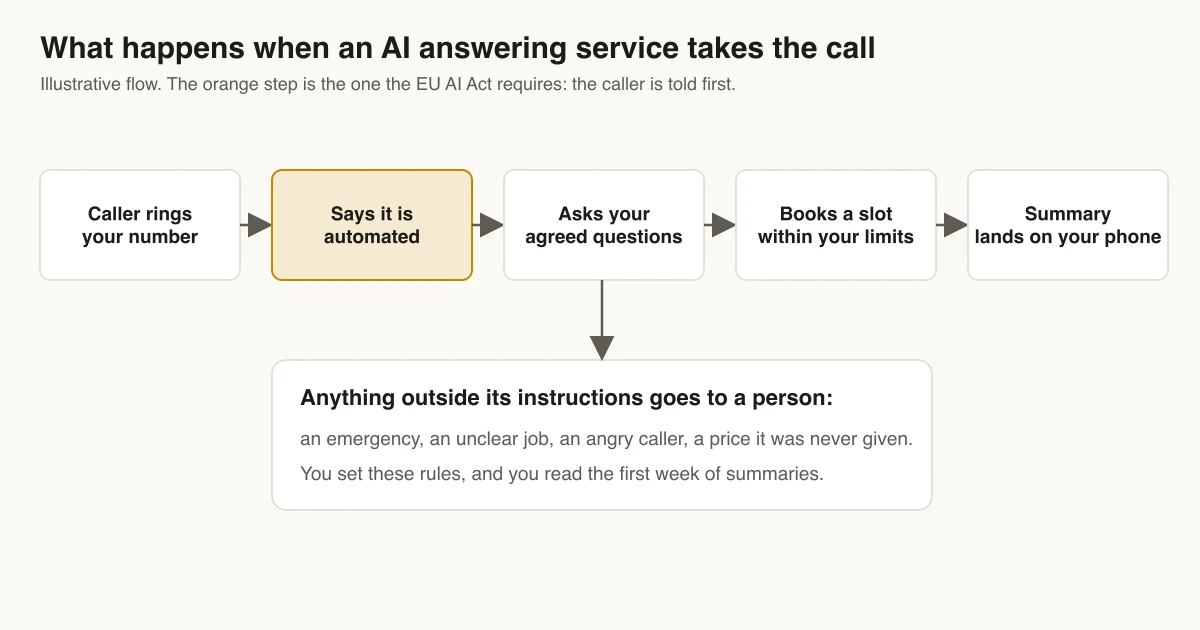
An AI answering service is software that answers your business phone with a synthetic voice, holds a short conversation, and passes the result to you. Some providers sell it as an AI phone answering service or an AI receptionist; the job is the same. For a trade firm, a good one does four things. It says up front that it is an automated assistant. It asks the questions you agreed: what the job is, where it is and how soon. It books or offers a slot within the rules you set, and it sends you a written summary of the call. Anything outside its instructions goes to a person.
That last part matters most. The service is only as good as the instructions it works from. For example, if you never told it that you do not take jobs under a certain size, it will happily book them.
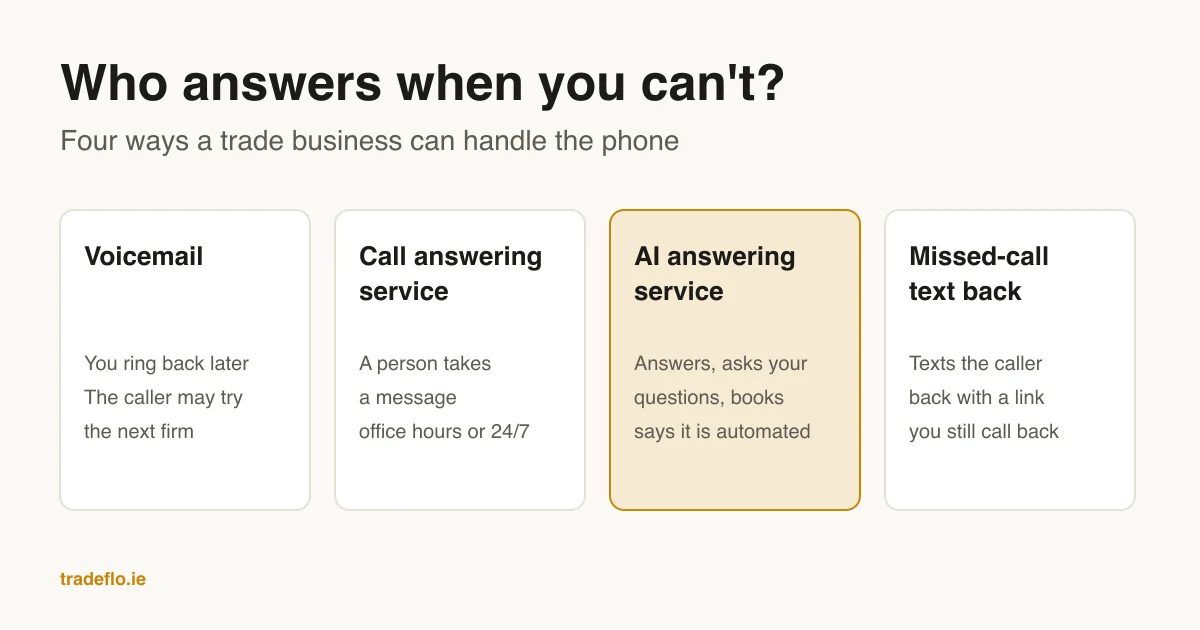
The four ways to handle the phone, side by side
| Option | Who answers | What you get after the call | Watch out for |
|---|---|---|---|
| Voicemail | Nobody | A recording, if the caller leaves one | The caller may try the next firm instead of leaving a message |
| Call answering service | A person in a call centre | A message by text or email | Hours, per-call charges, and how much they know about your trade |
| AI answering service | Software with a synthetic voice | A written summary, sometimes a booked slot | What it does with anything outside its instructions |
| Missed-call text back | Nobody, but a text goes out | A text thread with the caller | You still have to ring back, and some callers will not reply to a text |
Missed-call text back is the simplest of the four: when a call goes unanswered, the caller gets an automatic text so the conversation can carry on by message. These options are not exclusive. One setup that works is a person or an AI during the day and a missed-call text after hours, or an AI only in the evenings when you have stopped for the day. Our own enquiry handling covers calls, WhatsApp and web forms together for that reason.
Call answering service in Ireland: a person or an AI?
In Ireland, a call answering service is usually a call centre where a person answers in your business name and takes a message. That works well for simple messages and for callers who want to hear a person. It works less well when the caller needs a real answer about the job, because the person on the line does not know your trade, your area or your diary.
An AI answering service sits the other way round. It can know your services, your area and your free slots in detail, because you set them. It cannot read a situation the way a person can. For example, it will not notice that an elderly caller is confused, unless you have told it what to listen for and when to hand over.
A fair test for either option: ring it yourself as an awkward customer. Ask for a job you do not do, in an area you do not cover, at a time you are not free. Then read what lands on your phone.
Where an AI answering service falls short
- Emergencies. A burst pipe or a gas smell needs a person or a clear safety message, not a booking slot. Check what the service says and who it rings.
- Unclear jobs. "There is a noise in the attic" could be a plumber, an electrician or a roofer. It should hand these over, not guess.
- Angry callers. Someone chasing a job that went wrong wants a person. The service should pass them on straight away.
- Pricing questions. If it quotes a price you never agreed, you own that conversation. A safer instruction is to say a price follows the survey.
- Noisy lines. A caller on a building site or in a car can be hard to understand. Read a few summaries in the first week and check them against the calls.
What the law asks of an AI that answers your phone
Two sets of rules apply in Ireland and across the EU. The EU AI Act is the first: the EU's law on artificial intelligence, which entered into force on 1 August 2024. Article 50 puts the duty on the provider: AI systems that talk directly with people must be designed so those people are told they are interacting with an AI system, unless that is obvious from the context. The information has to be clear and given at the latest at the first interaction (AI Act, Article 50). The European Commission's summary gives the same example, chatbots, and says the transparency rules come into effect in August 2026 (European Commission, AI Act).
On a phone call it is rarely obvious, so in practice the first thing the caller hears should say it is an automated assistant. A service set up to pass as a person called Sarah works against that rule, and your firm's name is on the call.
The second is GDPR. A call recording or a transcript is personal data. The European Commission's guidance on the GDPR principles sets out four rules that matter here. Personal data must be processed transparently, collected only for a stated purpose, limited to what that purpose needs, and kept no longer than necessary (European Commission, GDPR principles). For a trade firm, that means knowing where recordings are stored, who can hear them and when they are deleted.
This is a summary of public guidance, not legal advice. If you record calls, check your privacy notice covers it.
Questions to ask before you sign up
- 01What does the caller hear first, and does it say it is automated?
- 02Can I set the questions it asks, and change them myself?
- 03What does it do with an emergency, an unclear job and an angry caller?
- 04Can it book into my own calendar, and can I limit which slots it offers?
- 05What lands on my phone after each call, and how fast?
- 06Where are recordings and transcripts stored, and for how long?
- 07Can I hear or read every call for the first few weeks?
- 08How do I switch it off for a day, and what do callers hear then?
How we set it up for a trade firm
Our AI receptionist answers at the times you choose, as an automated assistant for your business, and asks the questions you agreed. Customers can also describe the job by WhatsApp, under the same rules. We connect your Google Calendar and set which appointments it can offer, with your working hours and travel gaps between visits. You get a written summary of each enquiry, and unclear jobs or anything outside its instructions go straight to a person.
It is set up as part of enquiry handling, so calls, WhatsApp and web forms land in one place. Prices are on the pricing page.
Want your evening calls answered?
Tell us your trade, your area and the questions you always ask. We set up an assistant that asks them, books within your limits and sends you the summary.
See the AI receptionistQuestions people ask
What is an AI answering service?
It is software that answers your business phone, tells the caller it is automated, asks the questions you set, and sends you a written summary. Some can also book a slot in your calendar within limits you choose.
Is an AI answering service better than a call answering service?
It depends on the calls you get. A person suits simple messages and callers who want a human. An AI suits calls where the caller needs a real answer about your services, area or diary, as long as it hands anything unclear to a person.
Do callers have to be told they are talking to an AI?
Under Article 50 of the EU AI Act, the provider must design the system so people are told they are interacting with an AI, at the latest at the first interaction, unless that is obvious. The transparency rules apply from August 2026. In practice, pick a service whose first line says it is automated.
Can an AI answering service book jobs into my diary?
Many can, if you connect your calendar. Set which slots it may offer, your working hours and travel time between jobs, and confirm surveys and big jobs yourself.
What happens to call recordings?
Recordings and transcripts are personal data under GDPR. Ask the provider where they are stored, who can access them and when they are deleted, and make sure your privacy notice mentions them.
Sources
Written by
TradeFlo
Written by the TradeFlo team, checked against the sources listed
Fact-checked against the sources listed above before publishing. More about us. Spotted something wrong? Contact us and we will correct it.